

Let’s talk about something deeply weird that nobody wants to acknowledge: at some point in the late ’80s and early ’90s, America collectively decided it was totally fine to put a child murderer on lunchboxes, action figures, and breakfast cereal.
Freddy Krueger, the razor-fingered monster who explicitly murdered children in their dreams, became a beloved mascot. Kids wore his face on t-shirts. Parents bought Freddy dolls for Christmas. MTV gave him a talk show. He became less “horrifying embodiment of parental failure and childhood trauma” and more “that funny burned guy with the one-liners.”
And it all happened because of merchandise. Lots and lots of merchandise.
What Freddy Actually Was (Before the Lunchboxes)
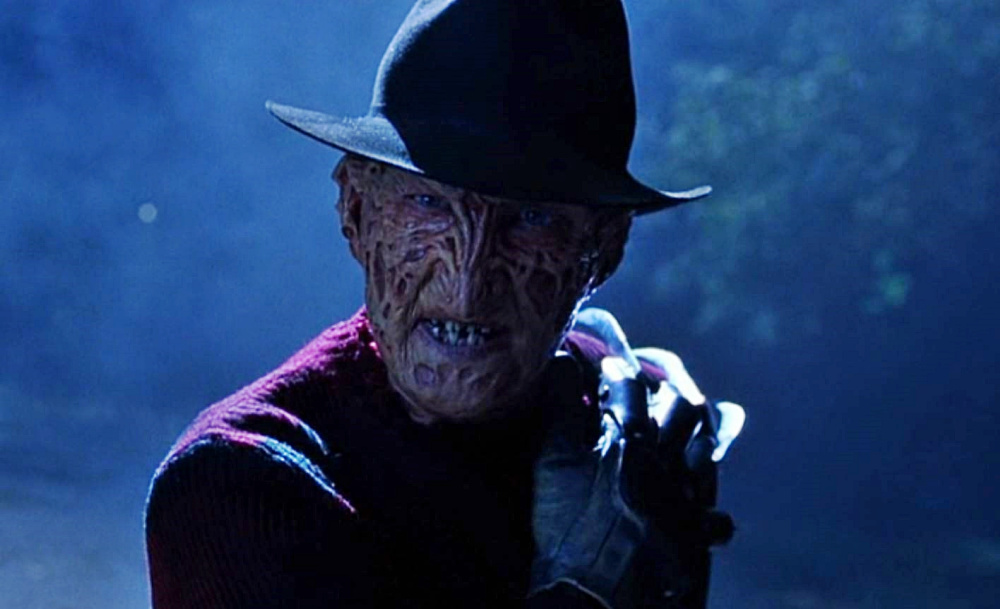
Let’s get uncomfortable for a second.
In Wes Craven’s original concept for A Nightmare on Elm Street (1984), Freddy Krueger wasn’t just a child murderer. He was a child molester. The film’s backstory explicitly positioned him as a predator who w abused the children of Springwood before the parents burned him alive in vigilante justice.
New Line Cinema made Craven change it. They thought the molestation angle was too dark, too real, too disturbing for audiences. So the theatrical version softened it to “child murderer” instead, still horrifying, but with just enough distance from real-world horror to be palatable.
Even with that change, the first Nightmare on Elm Street is genuinely terrifying. Freddy barely speaks. He’s a malevolent presence stalking teenagers, punishing them for their parents’ sins. When he does talk, it’s creepy whispers and menacing threats. There’s nothing funny about him. He represents every childhood fear made flesh, the monster under the bed, the thing in the closet, the unsafe adult who can hurt you when you’re most vulnerable.
Robert Englund’s performance is unnerving precisely because Freddy feels wrong. Predatory. Sadistic. The kind of thing that gives you nightmares.
Then came the sequels. And everything changed.
The Shift: When Horror Became Comedy

A Nightmare on Elm Street 2: Freddy’s Revenge (1985) was weird and queer-coded and kind of a mess, but Freddy was still mostly scary.
A Nightmare on Elm Street 3: Dream Warriors (1987) That’s where the needle moved.
Chuck Russell’s direction and the introduction of the “Dream Warriors” concept, teenagers fighting back with special powers, turned the franchise into something closer to a dark superhero movie. More importantly, it gave Freddy a personality makeover. He started cracking jokes. Making puns. Turning kills into elaborate set pieces with comedic timing.
“Welcome to prime time, bitch!” became an iconic line not because it’s scary, but because it’s fun. Freddy was becoming a showman. An entertainer.
And audiences loved it. Dream Warriors was a massive hit, earning $44.8 million domestic (huge for 1987 horror). It proved that funny Freddy sold tickets.
New Line Cinema, which literally became known as “The House That Freddy Built” because the franchise saved the struggling studio, took note. If funny Freddy made money, they were going to milk it for everything it was worth.
The Dream Master (1988) cranked the comedy up further. The Dream Child (1989) tried to get serious again and underperformed. By the time Freddy’s Dead: The Final Nightmare (1991) rolled around, the character had become full cartoon. Freddy Krueger went from nightmare fuel to court jester in less than a decade.
The Merchandise Explosion: Marketing Death to Children

Here’s where it gets truly bizarre.
Throughout the late ’80s and early ’90s, Freddy Krueger merchandise was everywhere. And we’re not talking about R-rated collectibles marketed to adult horror fans. We’re talking about products explicitly designed for children.
The greatest hits:
- Freddy Krueger action figures (LJN Toys, multiple versions)
- Talking Freddy dolls that said his catchphrases
- Freddy Krueger Halloween costumes (sized for kids)
- Board games
- Video games (multiple platforms)
- T-shirts sold in the kids’ section
- Lunchboxes
- Trading cards
- Comic books
- A Freddy Krueger hotline (1-900 number where kids could call and hear Freddy taunt them. Seriously)
New Line Cinema partnered with toy companies, apparel brands, and anyone willing to slap Freddy’s face on a product. By the early ’90s, Freddy Krueger was generating more revenue from merchandise than from actual movie tickets.
Let that sink in: a character whose entire existence is predicated on murdering children became a cash cow by selling products to children.
The Cultural Amnesia: How We Forgot What He Represents

The sanitization happened gradually, then suddenly.
The more Freddy cracked wise, the more he appeared on MTV’s Freddy’s Nightmares anthology series (where he was basically the Crypt Keeper), the more parents saw him as harmless. Just a character. A boogeyman, sure, but a fun boogeyman. The kind you could dress your kid up as for Halloween without anyone batting an eye.
Nobody seemed to remember, or care, that Freddy Krueger’s entire backstory involves him preying on children. That he’s not a supernatural force or an accidental monster. He’s a deliberate predator who continues hunting kids even after death.
The irony is suffocating: parents who would never let their children watch A Nightmare on Elm Street had zero problem buying them Freddy Krueger action figures.
Cultural amnesia set in. Freddy became divorced from his context. He was no longer about anything. He was just… there. A recognizable face. A brand. The specifics of his crimes became background noise, irrelevant to his marketability.
This is how capitalism works, of course. Take something transgressive, sand off the edges, repackage it as nostalgia, and sell it back to the masses. Freddy’s merchandising success is just an extremely uncomfortable example of the formula.
How Freddy Compares to Other Horror Icons

Freddy wasn’t the only horror villain getting merchandised in the ’80s and ’90s, but his transformation was uniquely thorough.
Jason Voorhees (Friday the 13th) also got the action figure treatment, but Jason stayed largely silent and menacing. He didn’t become a comedian. His kills weren’t played for laughs. The merchandise existed, but the character himself didn’t fundamentally change to accommodate it.
Michael Myers (Halloween) remained a pure force of evil. No jokes. No personality. No talk show appearances. The Shape doesn’t do product endorsements.
Chucky (Child’s Play) had a similar trajectory to Freddy, wise-cracking killer doll, but his franchise was always more self-aware about the absurdity. Bride of Chucky and Seed of Chucky leaned into camp intentionally. Don Mancini knew what he was doing.
Freddy’s shift felt different because it wasn’t intentional satire. It was pure commercial calculation. New Line Cinema figured out that funny Freddy sold better than scary Freddy, so they dialed up the comedy until the horror was an afterthought.
And it worked. For a while, Freddy Krueger was arguably more famous than any other horror icon. Kids who’d never seen the films knew who he was. That’s brand penetration.
The Reboot and the Return to Horror

By the 2000s, the Freddy brand had become so diluted that New Line tried to reset.
Freddy vs. Jason (2003) was a fun monster mash, but it didn’t recapture the terror of the original. Robert Englund’s Freddy was still quippy, still theatrical, still the version audiences had come to expect.
The 2010 reboot starring Jackie Earle Haley attempted to return Freddy to his roots. Darker, more serious, explicitly bringing back the child molester subtext that Craven originally envisioned. The redesigned makeup made him look more like an actual burn victim. The jokes were gone.
Critics hated it. Audiences were lukewarm. It made $115 million worldwide (decent but not spectacular) and killed the reboot franchise.
Turns out, after decades of Freddy merchandise and MTV appearances, nobody actually wanted scary Freddy anymore. The damage was done. The character had been fundamentally redefined by his own marketing campaign.
What This Says About Us

Here’s the uncomfortable truth: Freddy Krueger’s transformation from child predator to beloved icon says more about us than it does about the character.
We have an incredible capacity for cultural amnesia when it’s profitable or convenient. We can take something genuinely disturbing, a monster who preys on children, and through sheer repetition and repackaging, turn it into something safe. Marketable. Cute, even.
Freddy Krueger lunchboxes shouldn’t exist. Parents shouldn’t have been buying their kids action figures of a child murderer. But we did it anyway because somewhere along the line, we stopped thinking about what Freddy Krueger means and started thinking about what he sells.
Robert Englund, to his credit, has always understood the weird duality of the character. In interviews, he’s acknowledged that Freddy’s comedy persona made him accessible but also defanged him. He’s spoken thoughtfully about the character’s dark origins and the responsibility that comes with playing a predator, even a fictional one.
But Englund also cashed the checks. He showed up for the commercials, the talk shows, the merchandise campaigns. Can you blame him? The character made him a star and paid his bills for decades.
The Bottom Line

Freddy Krueger’s journey from nightmare monster to pop culture mascot is a masterclass in how merchandising can fundamentally reshape our perception of art.
The original A Nightmare on Elm Street was a dark, twisted exploration of guilt, trauma, and the sins of the parents being visited on the children. Freddy Krueger was a boogeyman in the truest sense. An embodiment of our deepest fears about childhood vulnerability and adult predation.
By 1991, he was selling Nintendo games and appearing on MTV.
The merchandise didn’t just capitalize on Freddy’s popularity. It actively transformed what the character represented. It made him safe. Funny. Family-friendly, somehow. It erased the horror and replaced it with branding.
And we bought it. Literally.
Today, you can walk into any Hot Topic and find Freddy Krueger merchandise sitting next to Sanrio characters and Disney pins. Nobody blinks. He’s just another nostalgic icon from the ’80s, filed away next to Teenage Mutant Ninja Turtles and Transformers.
The fact that his entire existence is predicated on murdering children? Just background noise. Doesn’t matter anymore. Hasn’t mattered for decades.
That’s the power of merchandising. It can turn a monster into a mascot, a predator into a product, and a nightmare into a lunchbox.
Sweet dreams, kids.
Freddy Krueger: still available on t-shirts, coffee mugs, and Funko Pops near you. The irony is not included.
https://www.youtube.com/watch?v=videoseries