
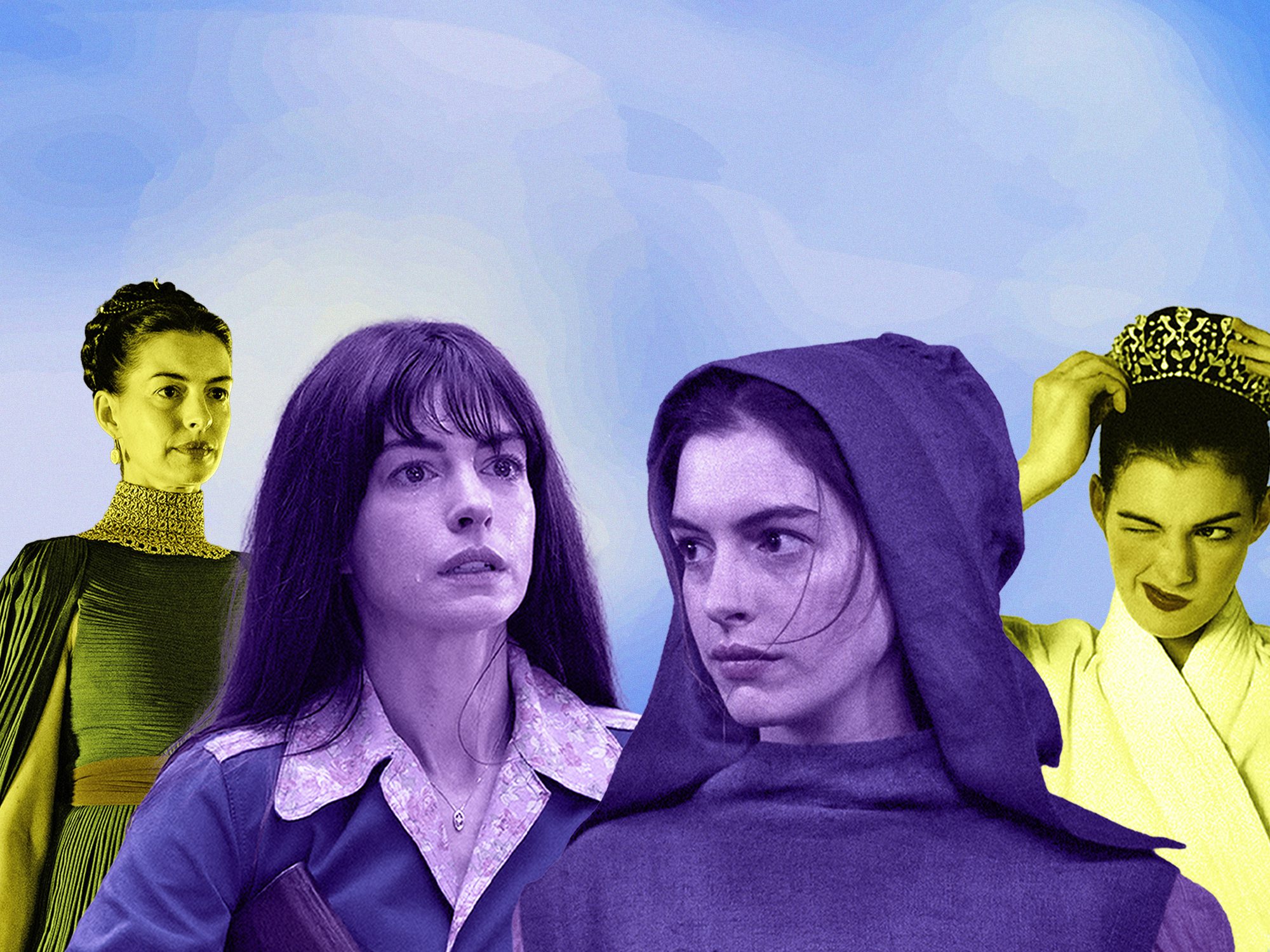
2026 might have been Gen Z’s breakout summer at the vanguard of culture, according to Vox. Yet it’s also been the season when millennials, now all firmly in their thirties and above, can finally identify their first undeniable generational talent. A quarter-century after Anne Hathaway’s breakthrough shot her to instant stardom, a stunning run of five roles (with one still to come this fall!) has solidified her status as more than just a generational talent. She’s a millennial emblem.
Hathaway burst onto the scene in 2001’s The Princess Diaries as a very different model of Disney royalty. Her gawky teen Mia Thermopolis leads a normal existence until a hitherto unknown grandmother re-emerges to deliver a wild ultimatum. Mia must either assume the title of “princess” by her sixteenth birthday, or forfeit her family’s claim to the throne of the fictional nation of Genovia. Royalty and status are not a given. They are an active choice.
Hathaway’s Mia ultimately undergoes a last-second change of heart and chooses not to abdicate that duty to a wider country. Her climactic speech plays now like a catalogue of millennial tics and hallmarks. The improvisatory, oversharing real-time broadcast to the world is a proto-social media missive. Mia’s self-deprecating, privilege-checking rambling ultimately settles into her decision to prioritize the “we” over the “me” in the spirit of civic responsibility that has become a defining generational trait. Stepping into herself and seizing the moment means paradoxically bridging solipsism and service.
A generation that mostly came of age during the unprecedented lull between the Cold War’s end and 9/11’s jolting kickstart to the War on Terror had good reason to believe they were special, but that sense of exceptionalism would inevitably collide with the harsh reality of the world. After playing a series of uniquely purpose-driven teen heroines, corporate America humbles Hathaway’s Andy Sachs in 2006’s The Devil Wears Prada by kicking her to the bottom of the totem pole. This idealistic recent journalism graduate learns to take her lashes working as the second executive assistant to a high-flying fashion editor. It takes a scolding for her supposed “whining” to dispel the naïve idea that she can circumvent the usual rites of passage acclimating to the business world. Hathaway’s visible makeover pales in comparison to the emotional transformation of a character learning to come into her own. Two decades on, the film remains an invaluable illustration of a generation beginning their crash course in capitalist ethics and the anxious pearl-clutching of their elders, who do not exactly pull out the welcome mat.
The 2008 financial crisis would cast a long shadow over the professional hopes of millennials, with hefty student debts leaving many overeducated and underemployed. That discontent began to manifest itself in darker characters representing a generational turn toward pessimism. Hathaway struggled to catch on as a more conventional headliner in studio genre fare like action capers (Get Smart) or rom-coms (Bride Wars) in her mid-twenties. Critical consensus, however, coalesced behind her embrace of somber material. She scored her first Oscar nomination for 2008’s Rachel Getting Married as Kym, a recovering addict whose unpredictable presence looms like a dark cloud over her sister’s titular nuptials.
Despite the growing complaints that Hathaway had resting “theater kid” energy – much of it unfairly directed following her ill-fated Oscar co-hosting gig with an aloof James Franco – these peak performances are remarkably free of mannered vanity. The scene that arguably won her the Academy Award for 2012’s Les Misérables, an unbroken take of “I Dreamed a Dream” sung live in close-up, has the effect of trapping viewers inside her character Fantine’s painful trajectory of downward mobility into outright destitution and desperation. It’s about as nervy and unglamorous a rendition of a Broadway standard that could ever be delivered, although a less charitable read could easily deride it as a classic bout of millennial narcissism delivered in direct-to-camera address.
Hathaway reached the zenith of her profession with an Oscar win at 30 – and no sooner did she utter the infamous phrase “it came true” in her acceptance speech than the swift backlash began, with hatred so constant and widespread that it received a well-known title: Hathahate. This phenomenon, at its core, was a repudiation of a high-achieving millennial fulfilling their ideals. The earnest pursuit of accomplishment, sold to a generation as virtue, quickly became recast as vice.
Understandably, Hathaway began to fade from view under such a withering spotlight. The period following her Oscar win is the closest thing the actor has had to a career wilderness: the few high-profile projects she did take on, from Christopher Nolan’s 2014 space epic Interstellar to Nancy Meyers’ The Intern, are characterized by somber reflection. A pragmatic astronaut trying to save human civilization and a girlboss attempting to preserve her entrepreneurial effort, respectively, do ultimately realize their goals.
Yet these victories prove so pyrrhic that, like many of her millennial peers entering adulthood, they lead to existential spirals about whether the results merit the effort. To an extent, these Hathaway characters settle for less. They seem to answer the lingering question of whether this generation of women could finally be the ones to “have it all” with a definitive no.
The actor’s next chapter finds something better than having it all: having fun, and refusing to take criticism sitting down. Few movies scream their star’s subtext quite like 2016’s Colossal, in which Hathaway’s Gloria learns her self-loathing literally manifests as a Godzilla-esque monster on the other side of the world. The character’s journey to harness and control that rage becomes crucial to protect both innocent South Korean citizens and herself.
If Colossal saw Hathaway dabbling with playing an anti-hero, she would turn to outright villainy with a delectable aplomb in films ranging from 2018’s Oceans 8 to 2019’s one-two punch of Serenity and The Hustle before capping off with 2020’s aptly titled The Witches. While hardly the most fruitful stretch of her career, these roles now look like a necessary reset for the actor to cast off any lingering self-consciousness and tune out the haters. She approached her late thirties and the last gasp of millennial youthfulness with equal parts defiance and pride: if Hathaway could not be the one to reconcile the contradictory expectations for contemporary women, she’d at least enjoy needling anyone who demanded the impossible.
Hathaway’s remarkable run spanning genres and scales has subverted the archetype traditionally associated with mid-career stagnation – the “mother” who exists solely to support a younger character’s self-discovery – and found a wide variety of shadings to play. Call it Mother’s Instinct, like the title of the rare misfire in her current run of maternal roles.
Her transition from being the young one to raising the young has been characterized by grace and generosity that do not stifle her individuality. She’s found rich thematic terrain to explore in the “mother” label that need not limit itself to mere child-rearing. Playing a world-famous fictional pop star in Mother Mary explores the moniker as it is often wielded by stan communities, with Hathaway’s titular artist weighing her obligations to friends and fans alike in charting her comeback.
Meanwhile, the return of Andy Sachs in The Devil Wears Prada 2 provided ample fodder for discussion around what has – and hasn’t – changed in the intervening decades between the two films. Andy continuing to find more nourishment from her professional life than her personal one felt like a refreshingly honest reflection of a generation of women who began to vastly outstrip the educational attainment of their male counterparts. Still, the maternal instinct remains in Andy as she tries to usher in a more humane, caring workplace that avoids inflicting unnecessary stress on her Zoomer underlings.
Even the most standard background figure of the bunch, Jewish matriarch Esther Graff in 2022’s Armageddon Time, comes loaded with doubt and ambiguity over how much the character reinvests her hope for the future in her sons. Hathaway’s third collaboration with Christopher Nolan in The Odyssey similarly resists turning Penelope into a flat Madonna figure. She invests the mythological figure with a steely and determined resolve that tries the patience of her husband, son, and suitors alike.
But perhaps a bigger challenge for Hathaway is instilling this sensibility inside a mother figure in The End of Oak Street, an action-adventure romp set in the year of her birth. Her Denise Platt feels entirely of a piece with the New Wave synth-pop playing behind a suburban block party in 1982, yet there’s an undeniably contemporary streak running through the character. She’s not content simply staying at home and tending to her teens’ needs. Instead, Denise is secretly penning a novel in between bouts of frustration at her underachieving husband’s inability to provide financial stability. When a cosmic event summons dinosaurs into their quiet cul-de-sac, it’s her strength and sagacity that point the way to survival.
Later in 2026, Hathaway will turn 44 – an age recently described by New York Magazine as the dreaded “millennial age cliff.” This generational talent, however, appears to be approaching this looming drop-off like the protagonists of Thelma and Louise; her latest reinvention gives us every reason to believe she will make the other side. If she can flip the script and navigate her way out of the dead-end mother part, then perhaps it’s not too presumptuous to assume Hathaway and her fellow millennials can live up to an aspiration once hopefully ascribed to them in 2000: The Next Great Generation.