
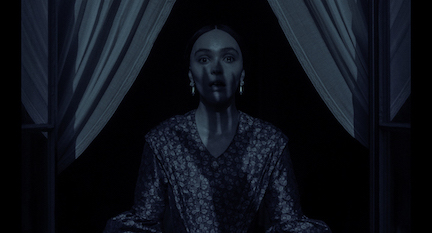
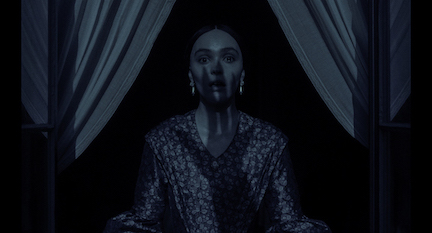
Cinema as a populist and commercialized art form has persisted for so long now that films over 100 years old are getting the reboot treatment. After years of development, Robert Eggers (The Lighthouse) has produced his long-awaited remake of F.W. Murnau’s Nosferatu, which comes out on Christmas Day. While it would seem that the time interim between remakes and their source material is getting shorter and shorter (looking at you, American Psycho), Eggers is reimagining a film that’s nearly as old as the cinematic medium itself.
Based on, or rather, ripped off from Bram Stoker’s Dracula, F.W. Murnau’s Nosferatu has collectively haunted popular culture for a century. With his crooked features, eternally long talon-like fingernails, and skeletal gauntness. Max Schreck’s Count “Orlok” was so unprecedentedly unnerving and chilling, that Schreck was rumored to be an actual vampire. Orlok, renamed Count Dracula for most modern releases, has continued to be one of our most iconic and prevalent cinematic fiends. This Zoomer isn’t ashamed to admit that his first introduction to Orlok was through none other than Spongebob Squarepants. Few other titans of terror could be such a ubiquitous cultural staple that they could blend into a children’s cartoon.
Eggers isn’t the first to remake Nosferatu. Werner Herzog made his own ode to Murnau’s masterpiece with Nosferatu the Vampyre in 1979, roughly 50 years after the original. So we’re on track to score a new Nosferatu every half-century. I look forward to seeing the next one when I’m 70.

A Nosferatu For The Modern Age
That said, Eggers is the first to reimagine Nosferatu for the 21st century and the first to remake it after the original’s centennial. Entire lifetimes have been lived between these two Nosferatus, and more importantly, the world has undergone drastic changes. That’s why Eggers’ version provides audiences with an invaluable contrast between the Nosferatu of 2024 and the Nosferatu of 1922. Not only can we use these two films to study the evolution of genre filmmaking and the vampire mythos, but we can also trace the arc of modern history to study the sociological forces that have shaped the two films.
As I mentioned, the world has undergone drastic changes between the release of Murnau’s and Eggers’ Nosferatu. In many ways, it’s unrecognizable. And yet, rather tragically, we haven’t come as far as we’d like. The Nosferatu of both 1922 and 2024 was produced after the onslaught of a global pandemic, while far-right nationalist movements fomented in the directors’ native countries. Have more things changed? Or, like Eggers reimagining this classic film, has the new millennium just reimagined the social and literal ills of the century that preceded it?
Obviously, the world has progressed dramatically on the frontier of technology. The World Wide Web. The atom bomb. Selfie sticks. Innovation was also visible in the continuing sophistication of film craftsmanship. F.W. Murnau could have only dreamt of playing with the toys currently at Robert Eggers’ disposal. As one of the premier auteurs of the motion picture, Murnau took the limited technology of his day and utilized visionary stagecraft and a mastery of light and shadow to construct the ultimate nightmare. In the process, he helped popularize techniques that are standard procedure today, such as the montage. Then there’s the make-up job that transformed Max Schrek into the eponymous Nosferatu, which shocked audiences years before The Phantom of the Opera set the gold standard for prosthetics and make-up appliances.

The Power Of Illusion in Nosferatu
Beyond bolstering the power of illusion, Murnau also proved that embracing authenticity could manifest in a film’s mood and atmosphere. He shot on location in the Carpathian mountains at a time when filming on plywood sets would have been the norm. But motion pictures weren’t just filmed stageplays—they were a medium unto themselves and had an unprecedented capacity to transport audiences and immerse them in an artist’s imagination.
Murnau could not have imagined that over 100 years from the release of his opus, the craft of filmmaking would have progressed so far technologically but regressed in terms of capturing authenticity. Surely, Murnau could not fathom that the majority of major motion pictures are filmed in “green screen” studios where entire environments can be engineered in post-production, or that the vast majority of special effects would be realized with “computer-generated imagery” in lieu of in-camera techniques.
Thankfully, the upcoming Nosferatu is helmed by a director who is famous for his love of austere craftsmanship and devotion to historical accuracy. So while Eggers’ Nosferatu will be a reinvention for modern audiences that utilizes many of the filmmaking practices that have become commonplace, it will also be a testament to the original’s primal understanding of the cinematic medium.
Still, it’s even more insightful to dissect the sociological context surrounding the release of both versions. No, sociology isn’t as “fun” as vampires, but it can be just as terrifying.
Nosferatu And A World Ravaged By War
The world circa 1922 was, by most accounts, a terrifying place. The globe had just been ravaged by World War I (then referred to as “The Great War”). Murnau’s native country of Germany was especially devastated thanks to the Treaty of Versailles. The preceding economic catastrophe and global humiliation cratered Germany’s morale, but it also bred the creative movement we now refer to as “German Expressionism.” In order to help cope with the seemingly senseless misery that Germans faced, artists and filmmakers embraced surrealism and artificiality to craft works of otherworldly quality and deeply ingrained tragedy.

While German Expressionism was technically a short-lived movement, it’s now considered one of the most impactful periods of film history. The influence of German Expressionism can be felt directly today through the works of auteurs like Tim Burton.
In contrast to the economic instability of Germany, the United States was one of the few major countries left relatively unscathed by the Great War. In fact, it emerged from the war as the first and sole superpower on the world stage thanks in part to the interventionist policies of President Woodrow Wilson. That said, Wilson is largely more remembered as a vicious racist who supported segregationist Jim Crow Laws and believed in the “Lost Cause” myth of the Civil War—that the Confederacy was morally righteous in their succession, which was motivated by their concerns over the unconstitutional actions of the federal government, and not their refusal to give up the practice of slavery. Wilson even screened the now-disgraced KKK propaganda film Birth of a Nation at the White House.
Contrast that to 2024, where America has elected (and re-elected) its first Black president. America has made significant strides in civil rights for marginalized communities, from people of color to the LBTQ+ community. Deviation from heteronormativity was, at most, a social taboo in the early 20th century. Now, same-sex marriage is the law of the land (for now).
I could go on about the legislative progress this country has made in the century since the Great War or the many battles we’ve faced around the world in combating and defeating bigotry in all its forms. The Civil Rights Act of 1964. The Voting Rights Act of 1965. This would unfortunately paint a lopsided and unbalanced portrait of 2024, however, as we must acknowledge the global disasters and reactionary forces that have set the stage for both Nosferatu films.
A World Ravaged By Contagion
Everyone reading this surely remembers living through the COVID-19 pandemic. We’re arguably still in it, thanks to all the variants partly enabled by vaccine “skeptics”. Still, nothing in our lifetimes will compare to the height of the pandemic. The stories of hospitals running out of body bags. Social distancing from others in line for groceries, making sure your mask was on good and tight. The lockdowns, which for some lasted weeks, and for others lasted months.
Again, there’s nothing comparable in our lifetimes. But 100 years ago, the world was in the grip of another global health emergency: the “Spanish Flu,” or the Great Influenza. Peaking between 1918 and 1920, the Great Influenza claimed over 50 million lives and infected around 500 million. Many governments across the globe were caught so off-guard by the disease that they publicly downplayed it, comparing it to a common case of the flu. Sound familiar?
The shadows of this public health emergency lingered on Murnau’s Nosferatu. Audiences of 1922 must have shuddered at the sight of Count Orlok’s army of rats spreading his “plague” across Germany. Orlok doesn’t just invade communities as the traditional Dracula has, using his charms and social status to infiltrate. No, Orlok infests communities and spreads his evils like a disease.
It’s worth noting that this theme of rampant disease is also prevalent in Herzog’s Nosferatu, which, similarly to The Thing, has been retroactively analyzed as an “AIDs” film. There’s something eerily foreboding about watching this updated sequence of the plague-spreading rats in Germany, knowing that the AIDs crisis was only a few years away from the film’s release.
If only the parallels ended at disease. But that wouldn’t capture the full scale of social unrest that bookended both ends of this centennial.
Social Unrest and Cultural Anxieties
You might have heard of a man named Donald Trump. He was President of the United States. And he’s going to be again. During both of his successful campaigns, Trump ran on a brazenly anti-immigration platform. He’s promised everything from building a wall on the southern border to deporting millions upon millions of migrants from Latin America. In many ways, Trump’s political career is the climax to a decades-long mission of the Far-Right to stop the flow of immigration from non-White countries. Or, as the president-elect would call them, “shit hole” countries.
As it turns out, xenophobia is not a new phenomenon. America had previously seen a steady influx of immigration through the latter half of the 19th century, after the boom of the Industrial Age. This significantly altered the ethnic and cultural makeup of the United States, which sparked a nativist backlash from the multi-generational families of Western European descendants who didn’t consider these Irish and Italian immigrants to be White. This produced open discrimination against these first-generation immigrants in the form of NINA laws and legislation such as the Immigration Act of 1917.
This xenophobic fear towards any community that doesn’t hail from Western Europe is unfortunately reflected in Nosferatu, and can be traced all the way back to Bram Stoker’s Dracula. Readers weren’t intrinsically terrified of Count Dracula just because he was a vampire, but because he was a Transylvanian, those supposedly savage descendants of Vlad the Impaler, who directly inspired the character.

A Shocking, Yet Unsurprising, Racist History
You could also make the case that Nosferatu is a product of an even uglier chapter of modern history. See, just two years before its release, a rising populist party in Murnau’s country of Germany would rename itself from the German Worker’s Party to the National Socialist German Worker’s Party. While their official acronym was the NSDAP, they would quickly become known as the Nazi Party.
Just a year before Nosferatu’s release, the Nazis would elect a new chairman who would lead them to power. That new chairman was a mustachioed WWI veteran and failed painter by the name of Adolf Hitler. Their furiously antisemitic rhetoric was already tapping into the collective antisemitism that undoubtedly (and unfortunately) influenced Murnau’s depiction of the eponymous Nosferatu as a crooked-nosed, rodent-like ghoul, who preyed on innocent gentiles and tried to violate their women. And who—let’s face it—sharply resembled the caricatures of anti-“Juden” Nazi propaganda. Whether or not Murnau himself was an anti-semite, the comparison between them is unavoidable.
The Nazi’s rabid anti-semitism and ultra-nativism didn’t just find support in The Fatherland, but with far-right parties all across the world. Even in the United States, where the American Nazi Party managed to hold a sold-out rally in Madison Square Garden in 1936.
I wish that I could say 1936 was the last time MSG was used for a Nazi rally. But then, Donald Trump held a campaign event there just one week before the 2024 election.
“That wasn’t a Nazi rally!” I can hear them shout. “Stop calling everyone a Nazi!” My bad. It wasn’t a Nazi rally; it was just a public speaking event featuring far-right personalities who ranted that their country was being invaded by Brown people, denigrated the IQ of their non-White opponent, and stumped for a man who famously bemoaned that his generals weren’t more like the “German” generals. Yeah, those German generals. Of course, that wasn’t the first time Donald Trump openly praised dictators, and it surely won’t be his last.
So if there’s one thing that gives me pause about seeing Nosferatu reimagined for today’s audience, it would be the resurgence of a notoriously anti-semitic coded figure in an age where anti-semitism has spiked. Unfortunately, the Alt-Right tried to co-opt Eggers’ last film, The Northman, which they saw as a celebration of that Aryan race thing that the Nazis loved so much.
Nosferatu: A Lover Letter To The Past And A Warning For The Future
In many ways, the continued resonance of F.W. Murnau’s Nosferatu is a triumph for both cinema and culture in general. It was a watershed moment for the medium and provided audiences with the greatest screen villains, even 100 years later. A love for Nosferatu is also a love for history–of the rich cultures that have preceded us, and the diverse tapestry of folklore that gives our existence texture, symbolism, and shared meaning. That’s why Nosferatu is so perfectly suited for Robert Eggers, who was already known for going to painstaking lengths to pay respects to cultures and peoples of the past. He hired a Romanian screenwriter to write dialogue in Dacian, an extinct language of the region. He shot on location in the Baltics and went so far as to construct a set the size of five city blocks in the German town of Wisborg.
Still, as we champion the release of a new Robert Eggers film and a retelling of literature’s most enduring vampire tale, we need to remember that these films are inherently products of their time. They’re not crafted in a vacuum, but in a sociopolitical reality that will shape not only the film itself but the film’s relationship to the audience. That can be at the core of films’ subtextual power, but it can make them unintended Trojan horses. Like the Nosferatu itself, there are some nefarious forces that refuse to die. They just keep getting up and lumbering towards us. So while we cheer on vampire slayer Willem Dafoe as he hunts down the Nosferatu, let’s keep the evil at bay. Be ready to put a stake in its heart, if you have to.
Categorized:Editorials