


Close Menu
Entertainment Industry Reporter
    Facebook X (Twitter) Instagram
    Entertainment Industry Reporter
    • Home
    • Film
    • Television
    • Box Office
    • Reality TV
    • Music
    • Horror
    • Politics
    • Books
    • Technology
    • Popular Music Videos
    • Cover Story
    • Contact
      • About
      • Amazon Disclaimer
      • DMCA / Copyright Disclaimer
      • Privacy Policy
      • Terms and Conditions
    Entertainment Industry Reporter
    You are at:Home»Film»In Praise of Hiroshi Teshigahara: Surveyor of the Abyss
    Film

    In Praise of Hiroshi Teshigahara: Surveyor of the Abyss

    By AdminJuly 31, 2026
    Facebook Twitter Pinterest LinkedIn Tumblr Email
    In Praise of Hiroshi Teshigahara: Surveyor of the Abyss


    As The Face of Another turns 60, the Japanese New Wave director’s cinematic battlegrounds of alienation, exploitation and fractured identity remain as haunting as ever.

    Sometimes, a sense of self can become a burden. The spectre of exploitation; the weight of labour on someone’s back; the impossibility of existing in a sprawling, endless space. These are the feelings that are drawn out of the protagonists of Hiroshi Teshigahara’s films. The Japanese New Wave director, best known for his 1964 masterpiece The Woman in The Dunes, has had a singular fixation ever since his 1962 debut feature, Pitfall: at what point does a person stop becoming a person? His films often take place across landscapes that threaten to swallow up his protagonists: in Pitfall, it’s the mines and their seemingly endless depths; in 1966’s The Face of Another, the sprawl of the metropolis renders his characters invisible. To spend too long in these places, is to risk disappearing entirely.
    Sometimes, as in Pitfall, this happens in the way that we might expect: through death. At once a ghost story and a murder mystery about industrial strife and worker exploitation, Teshigahara’s debut tells the story of a mine worker killed by a mysterious figure clad all in white, who then goes on to frame the union leader Otsuka, a figure bearing a striking resemblance to the Miner (both are played by Hishashi Igawa). While both the industrial strife of the murder plot, and the desperation that leads the anonymous Miner to the abandoned town where he meets his end, will be explored with greater clarity later in Teshigahara’s career with The Face of Another, his command of space, the ways in which it dwarfs and even threatens to destroy his miniscule human figures, is on full display from the very beginning. As he lies awake, waiting to find a way out of his situation, the Miner in Pitfall laments the idea of inevitably ending up at just another mine, or even being “reborn in hell,” something that lingers over Teshigahara’s characters. A morbid sense of invisibility grabs hold of these men; living or dying, with their own face or someone else’s, they seem to disappear into the world. 

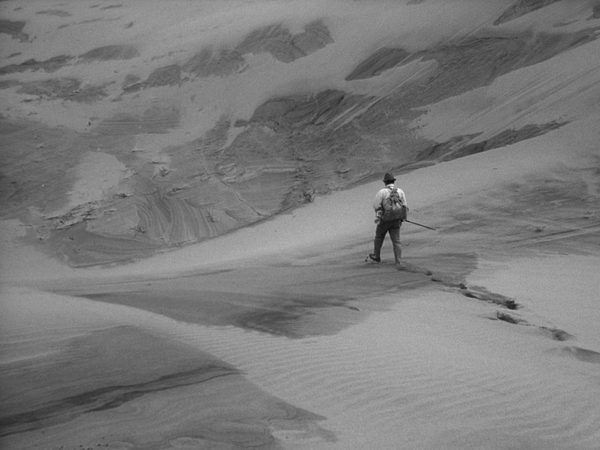
    The question of survival becomes a spiritual one: how does the soul survive in a world where the body is denied freedom or agency? In Pitfall, agency disappears along with the spark of life, leaving the Miner to navigate a world inhabited by silent, looping spirits in the abandoned town he moved to before his death. Woman in the Dunes takes these themes of endless labour and burrows into them even deeper: the entomologist Niki Jupei is trapped in a house in the dunes with an isolated young widow. If the two of them don’t dig out the sand that threatens them every night, the house will be buried alive. Without a ladder, it seems that there’s no way back up from the dunes. All that’s left is the unforgiving nature of the elements, and the constant labour that literally keeps the two characters alive. The film has a deeply elemental language, drawing emphasis to the heat of the sun, the length of the nights, and the shifting, ominous threat of the sands while continuously drawing visual parallels between Jupei, the widow, and the captured insects. These mere mortals are made tiny, inconsequential. Their lives begin and end with the labour that they have no choice but to perform over and over again, every other possibility shrinking before them. 

    In the final act, Jupei begs to be lifted from the dunes, not so that he can be free, but just so that he can see the sea and the horizon beyond it, yelling up at the villagers who keep him and the Widow trapped there and insisting he won’t try to escape. All he wants is thirty minutes – a number he quickly reduces to twenty, and then to ten. Anything outside of the confines of the dunes disappears before him to the point that even the possibility of escape, and that view of the horizon, lose their lustre. There is, he says to himself, always tomorrow. Tomorrow, and tomorrow, and tomorrow, until the last syllable of recorded time.

    Where Pitfall and Dunes strip away at a sense of self, through death or torturous labour, The Face of Another begins from one point of invisibility and considers what happens when another one is made available. The film follows Okuyama, an engineer recovering from the burns caused by an industrial accident who continues to wear bandages over his face even after the worst of it has healed. An enigmatic doctor offers him a second face: a mask made to fit over his burned skin, something that threatens to change Okuyama from within. There’s a tension that emerges here: while it makes him a literally anonymous, faceless figure, there’s no way to move away from himself. His secretary immediately waves him through – because who else would have a face like his? – and he describes himself as having “become a monster.” It’s when foregrounding the tactile nature and artificiality of the world surrounding Okuyama that The Face of Another comes to life, and zeroing in on the mask that becomes his second face. The dissonance between his old self and the one brought to the surface by a prosthetic face lies at the core of Teshigahara’s exploration of a vast, careless city unsettling the sense of self.

    Given the sense of inevitability that pervades Teshigahara’s cinema, with his characters beaten down by callous landscapes and brutal exploitation, it feels strange to suggest that each of them contains a flicker of hope. Even if it is something that can only be understood as an absence. By showing the ways in which it can be chipped away, Teshigahara displays a deep, empathic understanding of exactly what it is that’s being lost in his characters. There’s often a desire here for something new, something different or better than what currently exists. Before moving to a new town, the Miner in Pitfall talks about the possibility of being reincarnated as a union man; Okuyama is driven by the desire to return to the humanity that he feels he has lost the accident and the invisibility of his bandages (he so often looks like Claude Rains in The Invisible Man) but the darkness of these films comes from the way that Teshigahara’s characters can’t grasp onto this possibility, forced instead – by exploitation, by violence, by loneliness under capitalism – to see themselves disappearing, inch by inch, and moment by moment. 

    The post In Praise of Hiroshi Teshigahara: Surveyor of the Abyss first appeared on Little White Lies.


    Original Source Link

    Share. Facebook Twitter LinkedIn Email Telegram WhatsApp

    Related Posts

    We Finally Know What Happened To Scott Baldwin on General Hospital

    The Worst Marvel Costumes Ever

    Lee Cronin’s The Mummy (2026) Movie Review

    Fleabag at 10: A Legacy Shaped by Mistakes

    Evan Rachel Wood’s ‘Practical Magic 2’ Exit Just Got More Awkward

    ‘The Odyssey’ Leak Watched 50,000 Times Before It Was Removed

    Popular Posts

    Travis Scott Arrested for Trespassing and Disorderly Intoxication in Miami-Dade County

    Dancing with the Stars viewers conflicted as Rosie Perez takes over as guest judge

    Here’s What’s Coming to Wicked Horror TV in January 2024

    The Deceptively Tricky Art of Designing a Steering Wheel

    Daytime Emmys 2024: The Complete Winners List

    Migration review – A sorely underpowered duck tale

    Regretting You (2025) Movie Review

    Categories
    • Books (2,256)
    • Box Office (1,641)
    • Cover Story (43)
    • Events (34)
    • Featured (46)
    • Film (2,275)
    • Horror (2,260)
    • Lifestyle (9)
    • Music (2,345)
    • Music & Film Reviews (1)
    • Politics (1,405)
    • Popular Music Videos (1,694)
    • Reality TV (1,717)
    • Technology (2,267)
    • Television (2,044)
    • Uncategorized (1)
    Archives
    Useful Links
    • About
    • Contact
    • Privacy Policy
    • DMCA / Copyright Disclaimer
    • Amazon Disclaimer
    • Terms and Conditions
    Categories
    • Books (2,256)
    • Box Office (1,641)
    • Cover Story (43)
    • Events (34)
    • Featured (46)
    • Film (2,275)
    • Horror (2,260)
    • Lifestyle (9)
    • Music (2,345)
    • Music & Film Reviews (1)
    • Politics (1,405)
    • Popular Music Videos (1,694)
    • Reality TV (1,717)
    • Technology (2,267)
    • Television (2,044)
    • Uncategorized (1)
    Popular Posts

    Daisy: Killer Cryptid Hits Amazon Prime !

    Instagram Adds New Music Feature + It Feels Like the 2000s Again

    Who’s Watching Whom? 6 Mysteries and Thrillers with Razor-Wire Tension

    Israel-Iran strikes likely just the opening salvo as markets reel

    © 2026 Entertainment Industry Reporter. All rights reserved. All articles, images, product names, logos, and brands are property of their respective owners. All company, product and service names used in this website are for identification purposes only. Use of these names, logos, and brands does not imply endorsement unless specified. By using this site, you agree to the Terms & Conditions and Privacy Policy.

    Type above and press Enter to search. Press Esc to cancel.

    We use cookies on our website to give you the most relevant experience by remembering your preferences and repeat visits. By clicking “Accept All”, you consent to the use of ALL the cookies. However, you may visit "Cookie Settings" to provide a controlled consent.
    Cookie SettingsAccept All
    Manage consent

    Privacy Overview

    This website uses cookies to improve your experience while you navigate through the website. Out of these, the cookies that are categorized as necessary are stored on your browser as they are essential for the working of basic functionalities of the website. We also use third-party cookies that help us analyze and understand how you use this website. These cookies will be stored in your browser only with your consent. You also have the option to opt-out of these cookies. But opting out of some of these cookies may affect your browsing experience.
    Necessary
    Always Enabled
    Necessary cookies are absolutely essential for the website to function properly. These cookies ensure basic functionalities and security features of the website, anonymously.
    CookieDurationDescription
    cookielawinfo-checkbox-analytics11 monthsThis cookie is set by GDPR Cookie Consent plugin. The cookie is used to store the user consent for the cookies in the category "Analytics".
    cookielawinfo-checkbox-functional11 monthsThe cookie is set by GDPR cookie consent to record the user consent for the cookies in the category "Functional".
    cookielawinfo-checkbox-necessary11 monthsThis cookie is set by GDPR Cookie Consent plugin. The cookies is used to store the user consent for the cookies in the category "Necessary".
    cookielawinfo-checkbox-others11 monthsThis cookie is set by GDPR Cookie Consent plugin. The cookie is used to store the user consent for the cookies in the category "Other.
    cookielawinfo-checkbox-performance11 monthsThis cookie is set by GDPR Cookie Consent plugin. The cookie is used to store the user consent for the cookies in the category "Performance".
    viewed_cookie_policy11 monthsThe cookie is set by the GDPR Cookie Consent plugin and is used to store whether or not user has consented to the use of cookies. It does not store any personal data.
    Functional
    Functional cookies help to perform certain functionalities like sharing the content of the website on social media platforms, collect feedbacks, and other third-party features.
    Performance
    Performance cookies are used to understand and analyze the key performance indexes of the website which helps in delivering a better user experience for the visitors.
    Analytics
    Analytical cookies are used to understand how visitors interact with the website. These cookies help provide information on metrics the number of visitors, bounce rate, traffic source, etc.
    Advertisement
    Advertisement cookies are used to provide visitors with relevant ads and marketing campaigns. These cookies track visitors across websites and collect information to provide customized ads.
    Others
    Other uncategorized cookies are those that are being analyzed and have not been classified into a category as yet.
    SAVE & ACCEPT